To ensure the sound and smooth operation of business, Nihon Kohden has established a management framework to prevent risks in overall business operations and has prescribed methods for dealing with risks when they occur.
The Board of Directors is responsible for establishing basic policies concerning risk management in the overall Group business operations and ascertaining the improvement and promotion status of the Group-wide risk management framework. The Risk Management Supervisory Division is tasked with improving and promoting the overall risk management system of the Nihon Kohden Group. The risks present in the execution of business activities have been classified into nine types, and the Risk Management Divisions and Risk-Related Committees have been assigned to each risk type. The Risk Management Divisions provide training and support to operating divisions and subsidiaries with regard to their assigned risk types and report the system improvement and promotion status to the Risk Management Supervisory Division. The Risk-Related Committees report to the Board of Directors and Management Council on matters including assessments of management system appropriateness, validity, and effectiveness for related risk types. Additionally, focusing on significant risks identified by the Risk Management Committee, we collaborate with risk management officers in each department to periodically evaluate risks and review response measures. The Internal Auditing Department reports to the Representative Directors and the Board of Directors on risks discovered during audits.
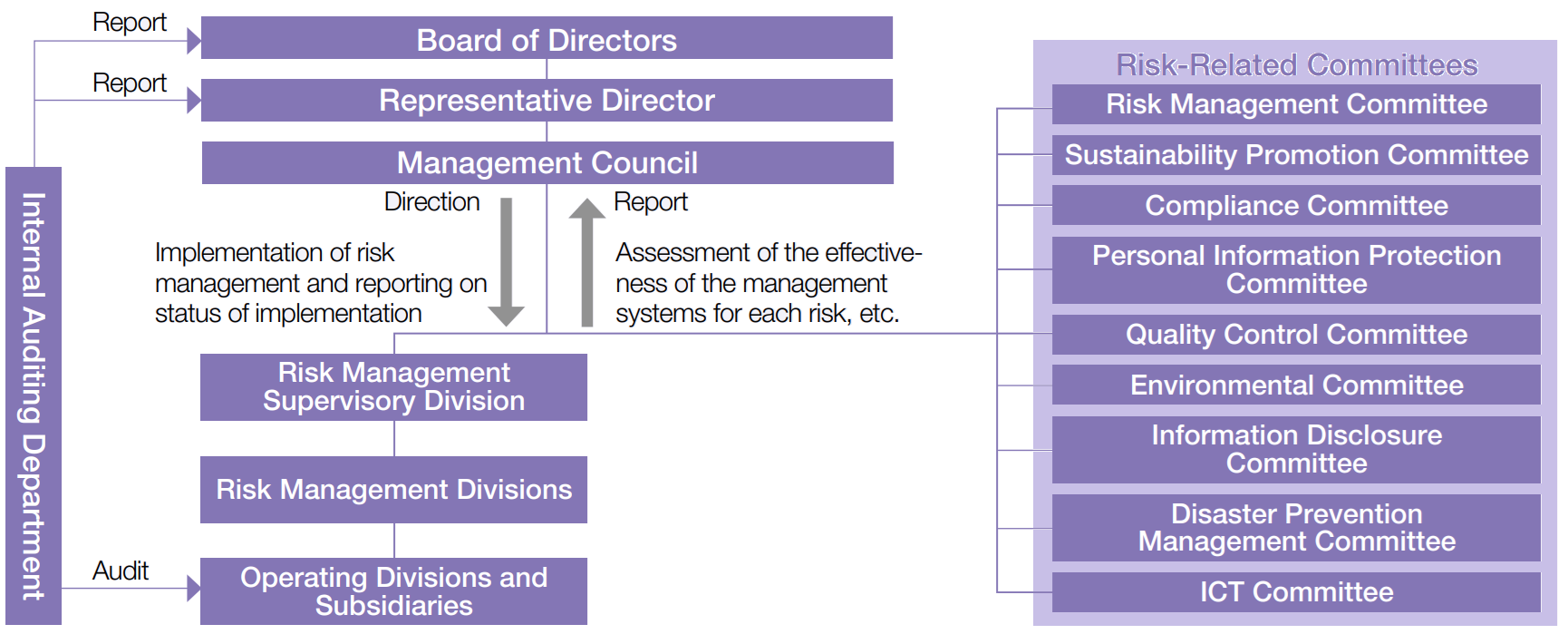
Nihon Kohden’s offices, subsidiaries, and the departments in the head office conduct self-assessment of risk management regarding compliance and others using divisional inspection sheets. The Risk Management Supervisory Division verifies the progress of risk management system implementation and future responses, and reports the results of the self-assessment to the Board of Directors. Overseas subsidiaries also report to the Board of Directors on the development and progress of their risk management systems and measures to strengthen the implementation.
In FY2024, as in FY2023, the Risk Management Committee reported significant risks identified to the Board of Directors and continued its efforts to enhance the company-wide risk management framework. For the identification of significant risks, we have evaluated the degree of impact on management and frequency of occurrence for each risk scenario by using risk maps. We have also identified severe risks based on risk assessment sheets prepared by each department and formulated response policies for each significant risk.
Additionally, e-learning on risk management including information security was conducted for the Group’s executives and employees. Regarding compliance, we made efforts to strengthen the global compliance system, and workplace study sessions were held in each department and subsidiary of the Group. Nihon Kohden ensures the practice of compliance by thoroughly disseminating the Nihon Kohden Code of Ethics and Conduct, which serves as the Group’s behavioral standard.
The Risk Management Committee has identified significant risks. The Committee has also appointed the relevant departments for risk management and response, and formulated action plans to address each risk. The progress of these action plans is regularly reviewed and reported to the Board of Directors.
We have established a global quality management system to address quality risks and a Computer Security Incident Response Team (CSIRT) to tackle information security risks, respectively. To mitigate compliance risks, we are enhancing employees’ awareness and knowledge through compliance training. In response to supply chain risks, we are working on optimizing inventory management and maintaining a stable supply system.
With regard to the Business Continuity Plan (BCP), we have reviewed the structure of the Emergency Response Headquarters established at the head office and conducted regular trainings so that we can respond quickly and appropriately in the event of an emergency. Through these measures, the Company has strengthened its ability to respond to risks such as natural disasters and has established a system that balances business continuity with the safety of employees.
The Risk Management Regulations, which set forth the basic policies for risk management, classify risks into the nine types of risk shown in the following table.
|
Risk |
Description |
|
Compliance Risks |
Risk of losses due to failure to comply with laws and regulations, etc. |
|
Quality Control Risks |
Risk of losses due to problems related to the safety or reliability of our products or services |
|
System Risks |
Risk of losses due to failure, malfunction or unauthorized use of networks and computer systems which are used in internal IT infrastructure, products and services |
|
Disaster and Accident Risks |
Risk of losses due to interruption of business operations caused by disasters or accidents |
|
Environmental Risks |
Risk of losses due to occurrence of environmental pollution, etc., caused by insufficiency in reduction of environmental impact or prevention of environmental pollution |
|
Financial and Accounting Risks |
Risk of losses due to change in value of assets held or inappropriate accounting practices |
|
Information Disclosure Risks |
Risk of losses due to inappropriate disclosure of information |
|
Strategic Risks |
Risk of losses due to incorrect business strategies |
|
Human Rights Risks |
Risk of being liable for compensatory damages or decrease in its corporate value due to human rights violations by the Company or its business partners |
The response to be taken when a risk occurs has been set forth in the regulations established for each risk type.
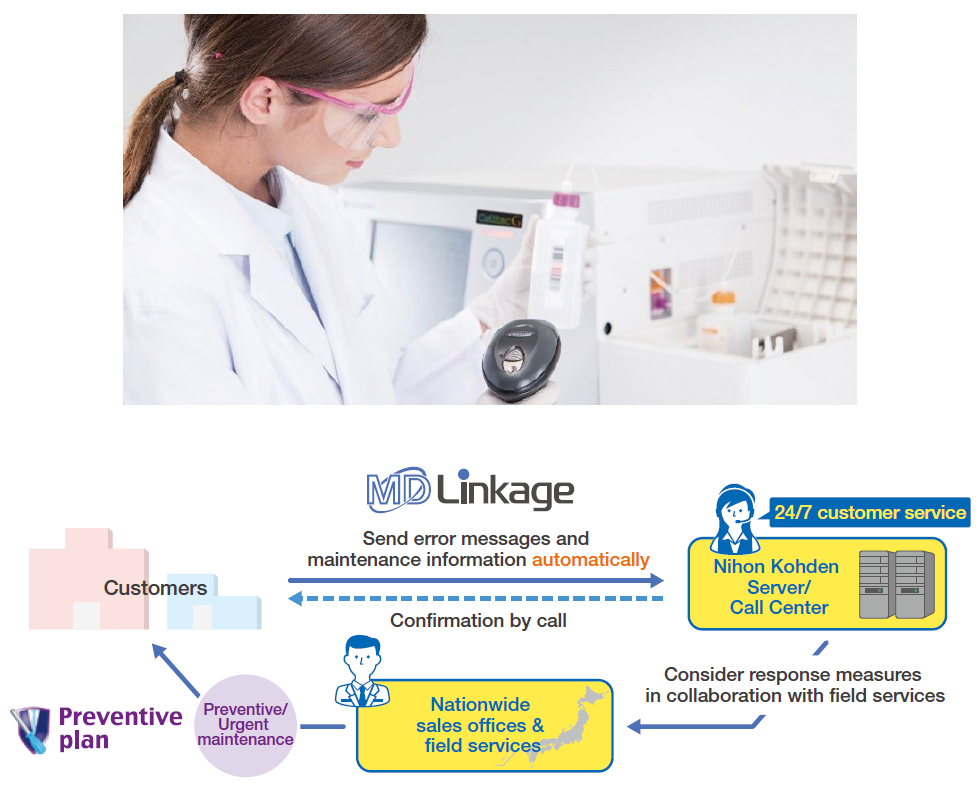
As a medical equipment manufacturer, Nihon Kohden focuses on product and service risk control to avoid accidents related to its products and services. In the event of accidents, troubles, or emergencies occurring at our customers, business partners, or any of the Nihon Kohden Group’s business locations, we have established and operated a reporting system to promptly implement countermeasures and minimize damage or harm.
Furthermore, to enable both prevention and rapid response, we have established and operated a system to collect information quickly and accurately from clinical practice, as well as a framework for appropriately disseminating necessary information.